From four steps to one
A robot-domain four-step teacher guides a one-step video generator through distribution matching. Trajectory supervision and multi-layer DINOv3 alignment preserve manipulation-relevant entities and dynamics.
Distilling Interaction-Centric Dynamics into One-Step Denoising for World Action Models
Static backgrounds form early during video denoising. The gripper, object, and their interaction become clear later. Truncating the teacher after one step loses precisely the future dynamics that robot control needs.
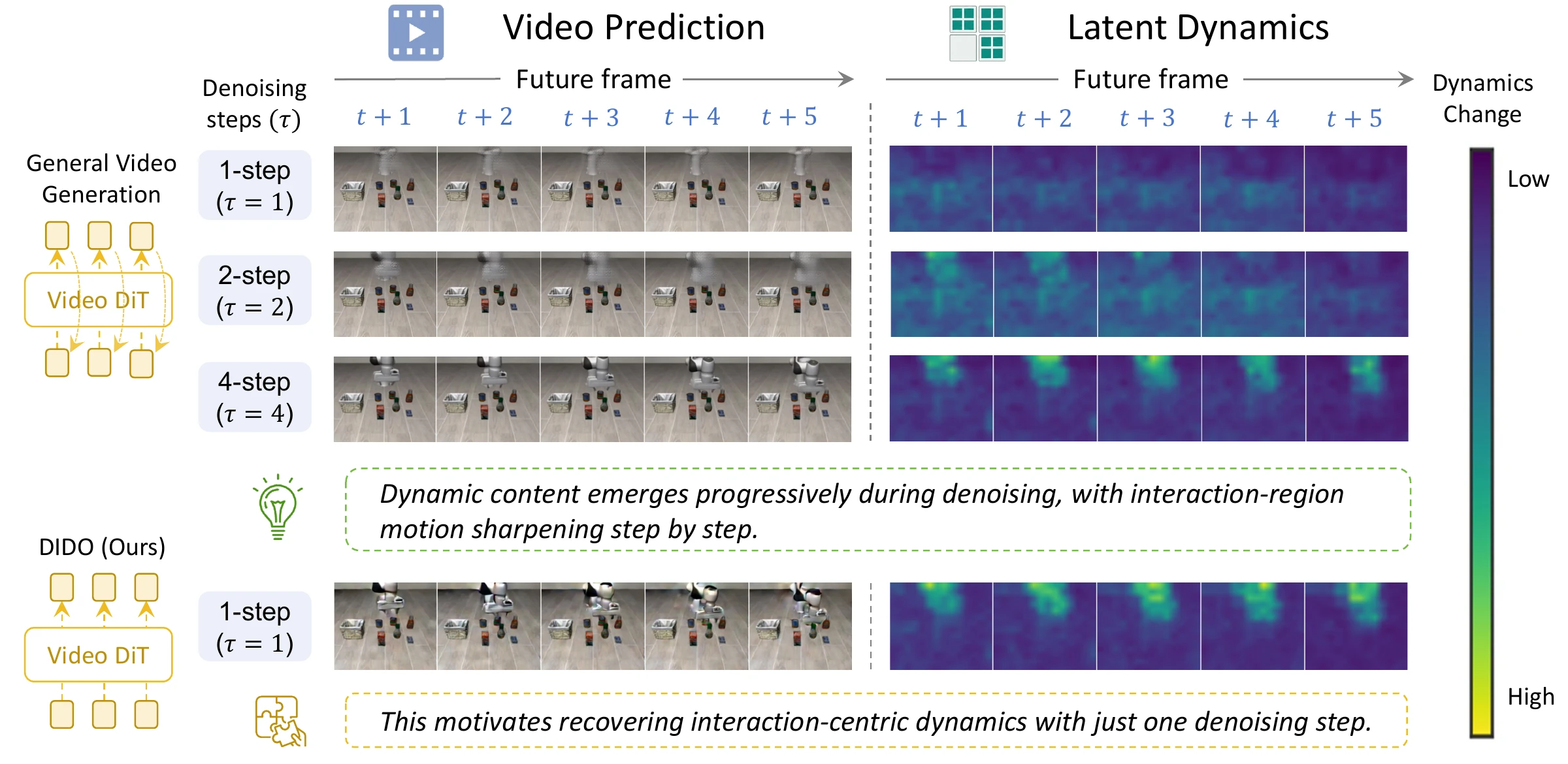
The four-step teacher progressively resolves interaction regions. DIDO learns to recover these dynamics within a single video denoising step.
Original PDF ↗World Action Models (WAMs) use video generation models to predict future visual dynamics for robotic manipulation, but iterative denoising introduces additional latency for closed-loop control. We empirically find that visual content converges at different rates during denoising. Static background structure forms early, whereas the gripper and manipulated object remain blurry after the first step, with their interaction dynamics emerging only through subsequent denoising. Consequently, naively truncating a multi-step video model to one step preserves scene structure but loses the interaction-centric dynamics most critical for manipulation. To address this issue, we propose DIDO, which distills the converged dynamics of a multi-step video model into a single denoising step. DIDO combines distribution matching distillation with interaction-centric representation guidance. Beyond compressing multi-step generation into one forward pass, DIDO explicitly models the gripper, manipulated object, and their interaction using supervised bounding-box visual reasoning tokens. Additionally, DIDO aligns the target object’s representations across multiple model layers with features from a pretrained DINOv3 encoder. This interaction-centric guidance helps the distilled model preserve both the relevant entities and their future dynamics in a single step, while substantially reducing inference latency. DIDO achieves an average success rate of 99.0% on LIBERO, 76.6% on LIBERO-Plus, and 92.0% on RoboTwin, while also demonstrating effective transfer to long-horizon and generalization tasks in real-world robotic manipulation.
DIDO combines one-step distribution matching with explicit supervision for the object, gripper, and their joint motion. An action expert reads the resulting latent representations directly.
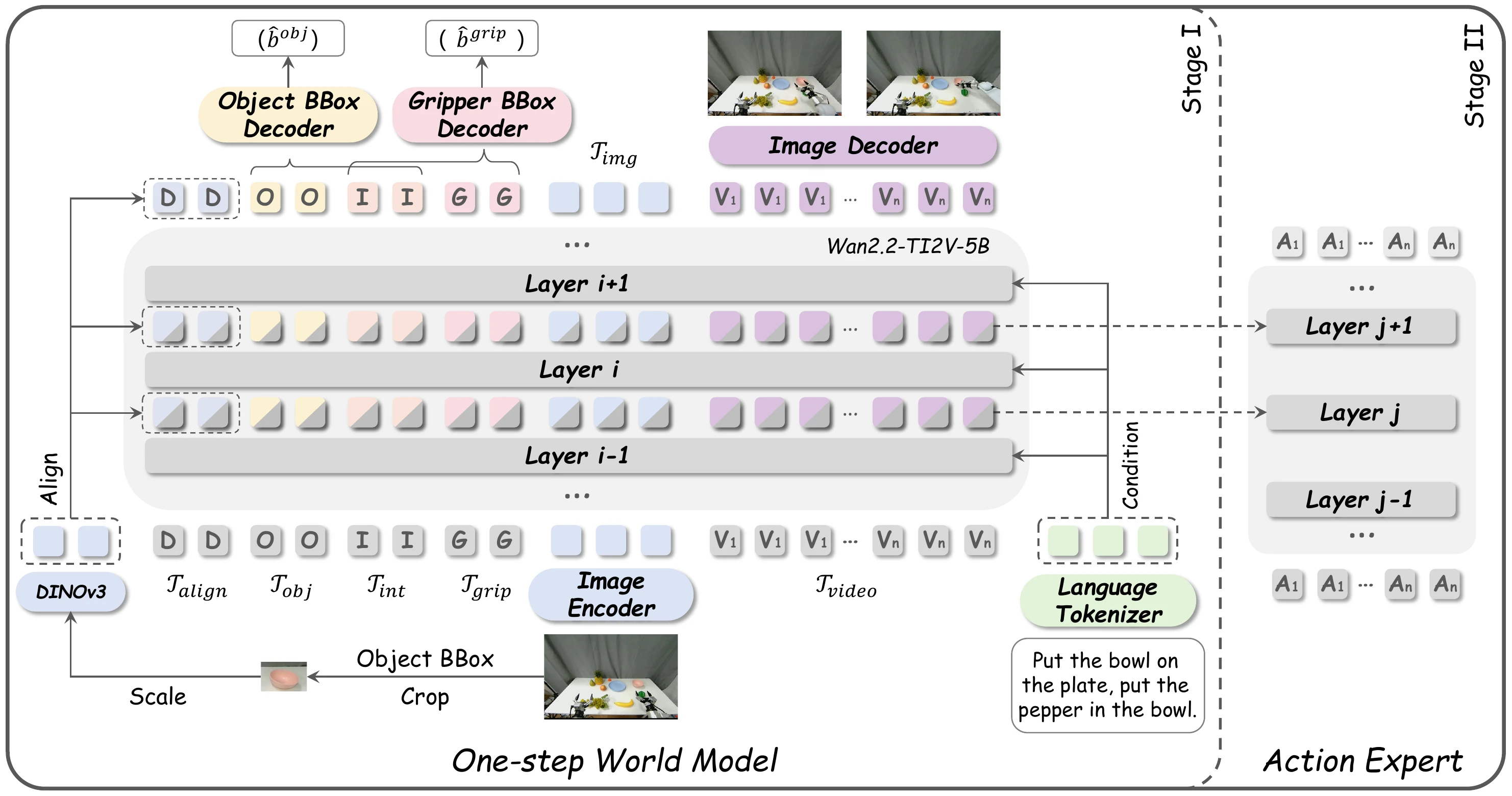
Four token groups guide the one-step world model. Shared interaction tokens support both bounding-box prediction branches; DINOv3 supervises object-centric alignment across multiple layers.
Original PDF ↗A robot-domain four-step teacher guides a one-step video generator through distribution matching. Trajectory supervision and multi-layer DINOv3 alignment preserve manipulation-relevant entities and dynamics.
The world model and action expert are optimized jointly, retaining video, interaction, and alignment objectives. The action expert attends to the full latent stream, without decoding and re-encoding future frames.
“One step” refers to the video world model. The flow-matching action expert still uses iterative action generation. Distribution matching is used in Stage I only.
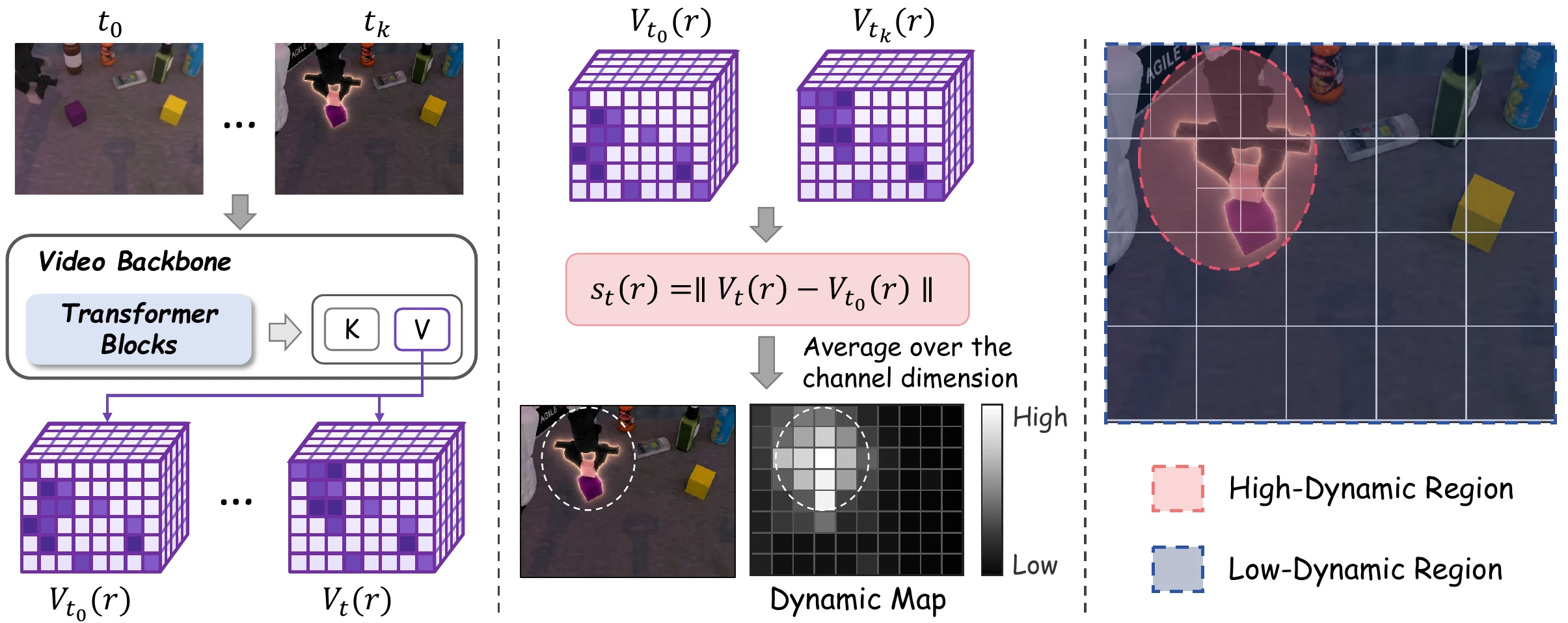
Value-feature differences identify dynamic regions. Of 20 regions in a 4 × 5 grid, each containing 2 × 2 cells, DIDO retains the top three at fine resolution and pools the remaining 17.
The conditioning context falls from 323 to 191 tokens, reducing end-to-end latency by approximately 30 ms in the paper’s evaluation.
DIDO reaches 99.0% on LIBERO and 76.6% on LIBERO-Plus. On RoboTwin, its 92.0% average is the strongest reported result among methods without embodied pretraining.
| Method | Emb. PT | LIBERO | RoboTwin | ||||||
|---|---|---|---|---|---|---|---|---|---|
| Spatial | Object | Goal | Long | Average | Clean | Rand. | Average | ||
| π₀ | Yes | 96.8 | 98.8 | 95.8 | 85.2 | 94.1 | 65.9 | 58.4 | 62.2 |
| π₀.₅ | Yes | 98.8 | 98.2 | 98.0 | 92.4 | 96.9 | 82.7 | 76.8 | 79.8 |
| LingBot-VA | Yes | 98.5 | 99.6 | 97.2 | 98.5 | 98.5 | 92.9 | 91.5 | 92.2 |
| Motus | Yes | 96.8 | 99.8 | 96.6 | 97.6 | 97.7 | 88.7 | 87.0 | 87.8 |
| Faster-WAM | No | 98.4 | 100.0 | 97.0 | 97.8 | 98.5 | 89.7 | 88.6 | 89.2 |
| Flash-WAM | No | 97.0 | 92.8 | 96.4 | 98.0 | 96.1 | 88.4 | 82.7 | 85.5 |
| Fast-WAM (No co-video) | No | 89.2 | 99.2 | 95.4 | 90.0 | 93.5 | 82.8 | 84.8 | 83.8 |
| Fast-WAM | No | 98.2 | 100.0 | 97.0 | 95.2 | 97.6 | 91.9 | 91.8 | 91.8 |
| DIDO (No co-video) | No | 97.8 | 99.4 | 97.2 | 96.4 | 97.7 | 89.6 | 89.0 | 89.3 |
| DIDO | No | 99.8 | 99.6 | 98.6 | 98.0 | 99.0 | 92.0 | 92.0 | 92.0 |
| Method | Emb. PT | Camera | Robot | Language | Lighting | Background | Noise | Layout | Average |
|---|---|---|---|---|---|---|---|---|---|
| OpenVLA-OFT | Yes | 56.4 | 31.9 | 79.5 | 88.7 | 93.3 | 75.8 | 74.2 | 69.6 |
| π₀ | Yes | 81.4 | 13.8 | 58.8 | 85.0 | 68.9 | 6.0 | 79.0 | 53.6 |
| X-VLA | Yes | 96.0 | 23.4 | 75.7 | 88.2 | 71.8 | 89.7 | 62.7 | 71.4 |
| Fast-WAM | No | 53.7 | 16.4 | 68.9 | 78.2 | 60.7 | 44.5 | 37.7 | 51.5 |
| ST-WAM | No | 55.4 | 60.1 | 79.3 | 93.0 | 74.2 | 79.5 | 74.3 | 72.8 |
| Faster-WAM | No | 57.0 | 67.9 | 92.1 | 94.3 | 82.7 | 49.0 | 82.3 | 75.0 |
| DIDO | No | 45.3 | 74.3 | 94.4 | 96.6 | 72.7 | 75.0 | 83.3 | 76.6 |
Simulation results are success rates. “No co-video” removes the video-generation objective during policy learning. Averages follow the manuscript's reported values; on RoboTwin, DIDO is the strongest method without embodied pretraining.
DIDO is built cumulatively from the one-step truncation baseline. Naively truncating the fine-tuned four-step video model to one denoising step achieves 97.7% on LIBERO and 71.4% on LIBERO-Plus.
One-step distillation preserves more of the converged multi-step dynamics within a single step, improving performance to 98.3% and 72.3%.
Adding interaction-centric visual reasoning explicitly models the target object, gripper, and their interaction, raising performance to 98.9% and 75.9%.
Finally, dynamics-based token refinement achieves 99.0% and 76.6% while reducing the conditioning context from 323 to 191 tokens and end-to-end latency by approximately 30 ms. The larger improvement on LIBERO-Plus suggests that selectively compressing near-static regions is particularly beneficial under visual distribution shifts.
| Configuration | LIBERO | LIBERO-Plus |
|---|---|---|
| One-step truncation | 97.7 | 71.4 |
| + One-step distillation | 98.3 | 72.3 |
| + Interaction-centric reasoning | 98.9 | 75.9 |
| + Dynamics-based refinement | 99.0 | 76.6 |
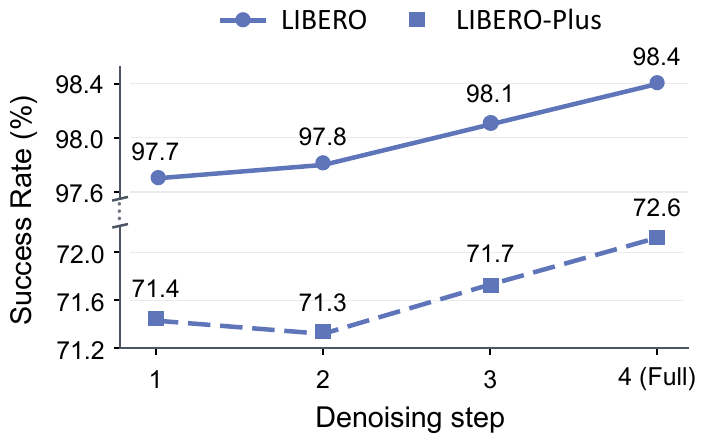
With the same trained four-step video model and action expert, later denoising representations improve LIBERO from 97.7% to 98.4% and LIBERO-Plus from 71.4% to 72.6%.
This experiment studies the teacher before DIDO distillation. Performance generally improves as denoising proceeds, confirming that later steps expose additional action-relevant dynamics.
On an NVIDIA H100 with batch size 1, DIDO predicts an action chunk in 384 ms end to end, compared with 562 ms for the four-step teacher, yielding a 32% latency reduction while improving LIBERO performance from 98.4% to 99.0%.
Compared with Fast-WAM, which removes future imagination at inference, DIDO introduces only 28 ms of additional latency while improving performance by 1.4 points on LIBERO and 25.1 points on LIBERO-Plus.
Four manipulation tasks on Galbot G1, with 150 demonstrations per task. The basic protocol evaluates position generalization; the advanced protocol evaluates both position generalization and environment generalization. Policies are evaluated without additional adaptation.
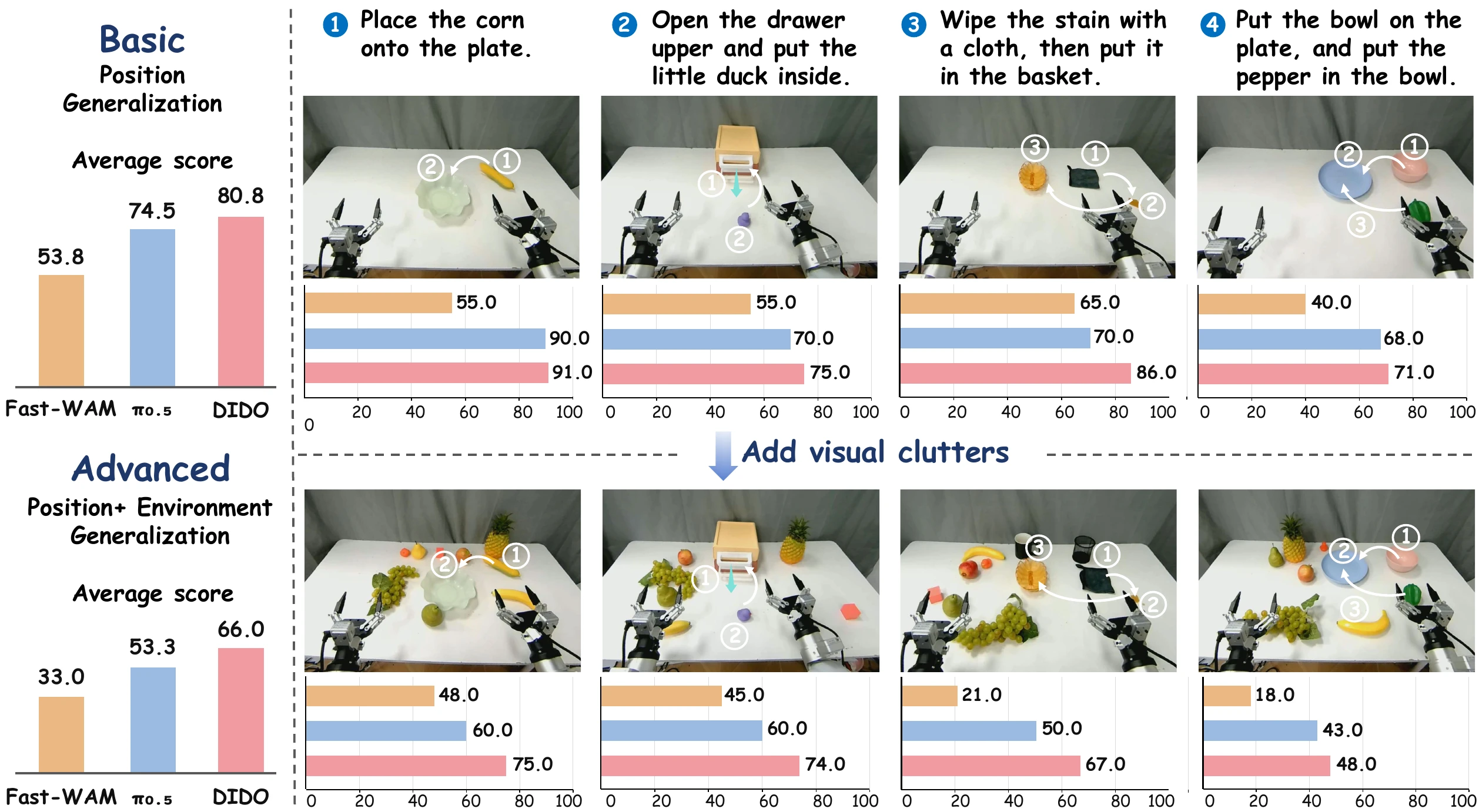
Each rollout receives a staged score on a 10-point scale, normalized to a percentage of the maximum. Evaluation uses 10 rollouts per task under each protocol. These are task-progress scores, rather than binary success rates.
| Method | Basic | Advanced |
|---|---|---|
| Fast-WAM | 53.8 | 33.0 |
| π₀.₅ | 74.5 | 53.3 |
| DIDO | 80.8 | 66.0 |
Read the paper on arXiv or visit DIDO-WAM on GitHub.
@misc{lyu2026didodistillinginteractioncentricdynamics, title={DIDO: Distilling Interaction-Centric Dynamics into One-Step Denoising for World Action Models}, author={Jing Lyu and Shuanghao Bai and Runze Xiao and Zhenyu Liao and Wenxing Tan and Zihan Tang and Ruochuan Shi and Cheng Peng and Yuheng Ji and Yihao Wang and Badong Chen and Pengwei Wang and Zhongyuan Wang and Xiaoguang Zhao}, year={2026}, eprint={2609.15570}, archivePrefix={arXiv}, primaryClass={cs.RO}, url={https://arxiv.org/abs/2609.15570},}